34 Fd Sqn RE
The Post Crown Road
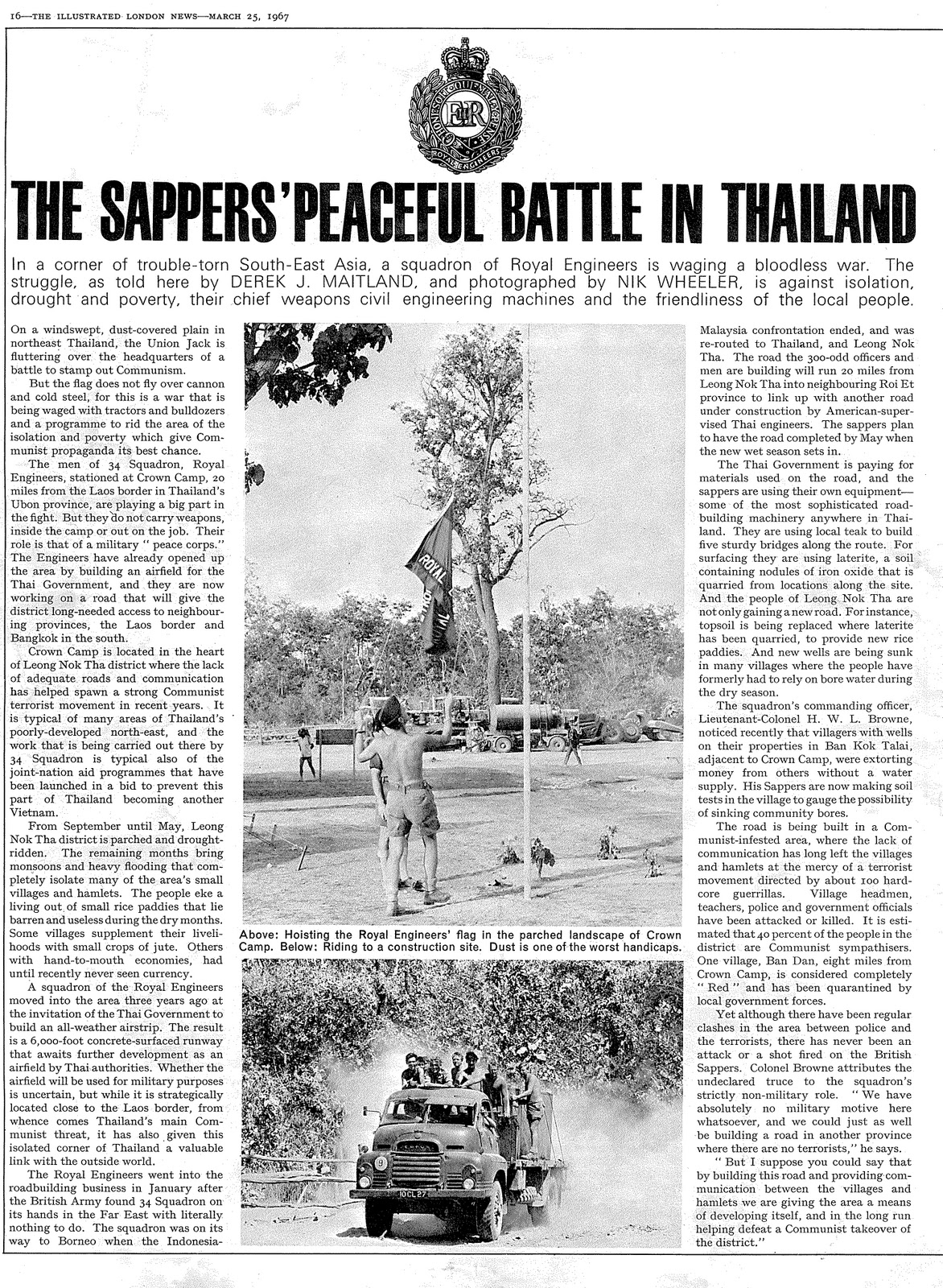
After the official opening of the concreteing phase of Crown airfield, a re-organization at CROWN left Major John Isaacs the O/C of 34 Fd Sqn, as the Post Crown Force Commander. During the first phase of POST CROWN, 34 Sqn were to build the first fourteen kilometres and five of the fourteen bridges between January and May 1967. Major Isaacs worked closely with Major Freddie Rose, the first Project Officer of the Post Crown Road. |
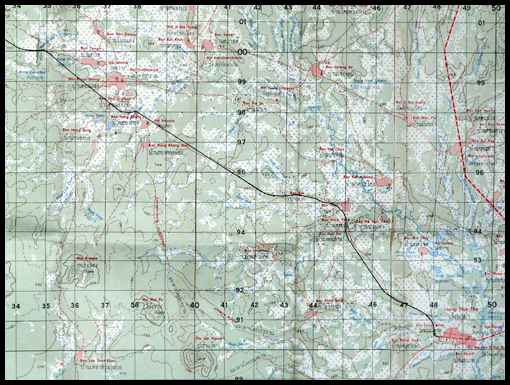
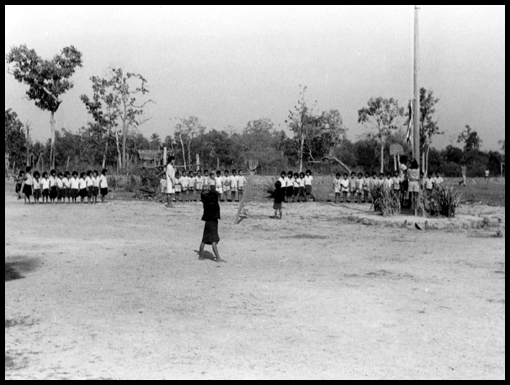
The Monsoon season starts in this part of Thailand from May onwards. It was vital to get as much done as possible before the rains set in. 34 Fd Sqn's target was twelve kilometers of earthworks, five bridges and twelve culverts. Work started from Loeng Nok Tha with the bulk of the plant and manpower. A temporary camp was set up in the Ban Hong Khong school grounds. As plant and men became available, they worked backwards to join the road from Loeng Nok Tha. |
|
|
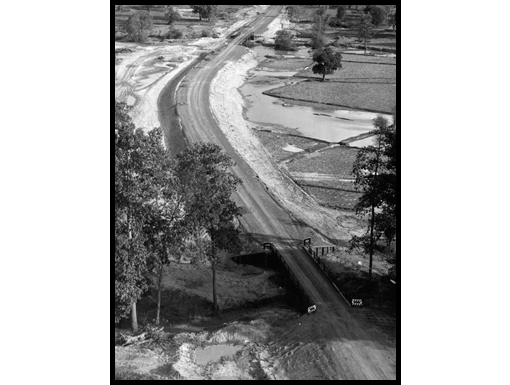
1 Troop under the auspices of Lt Baines and S/Sgt Thomas, were tasked with building bridges one, two. and three. A tower was built to house the G10 stores on the ground floor and an observation deck on the top floor. Staff Thomas used this observation deck to keep an eye on his charges and check the progress of the work. The rollover image has an aerial view of the completed bridges and the embankment between them. This embankment was the first major earthworks of the Post Crown Road. |
2 Troop Under the command of Capt. E Green were detached to the village of Ban Hong Khong some 25 kilometers from Crown Airfield. They were to build a tented camp and reside there. The start of the road was on the north western edge of Loeng Nok Tha now known as Leong Geow. The distance to Hong Khong school is some 12 kilometers from the road start (now beside a PT filling station). Sgt Dave (Satch) Higgins was the troop senior NCO as S/Sgt 'Doughy' Baker had returned to the UK on medical grounds. |
|
|
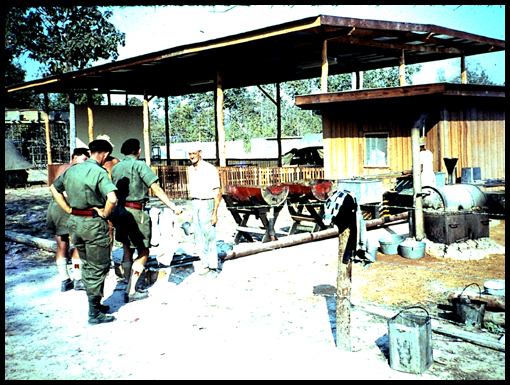
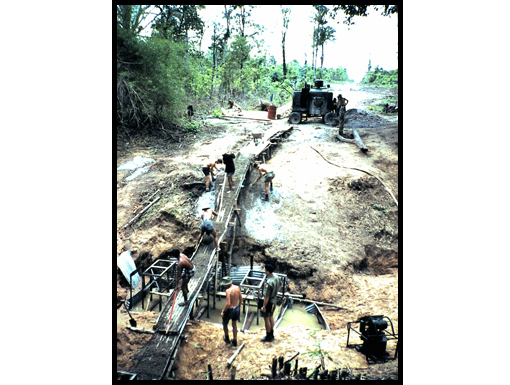
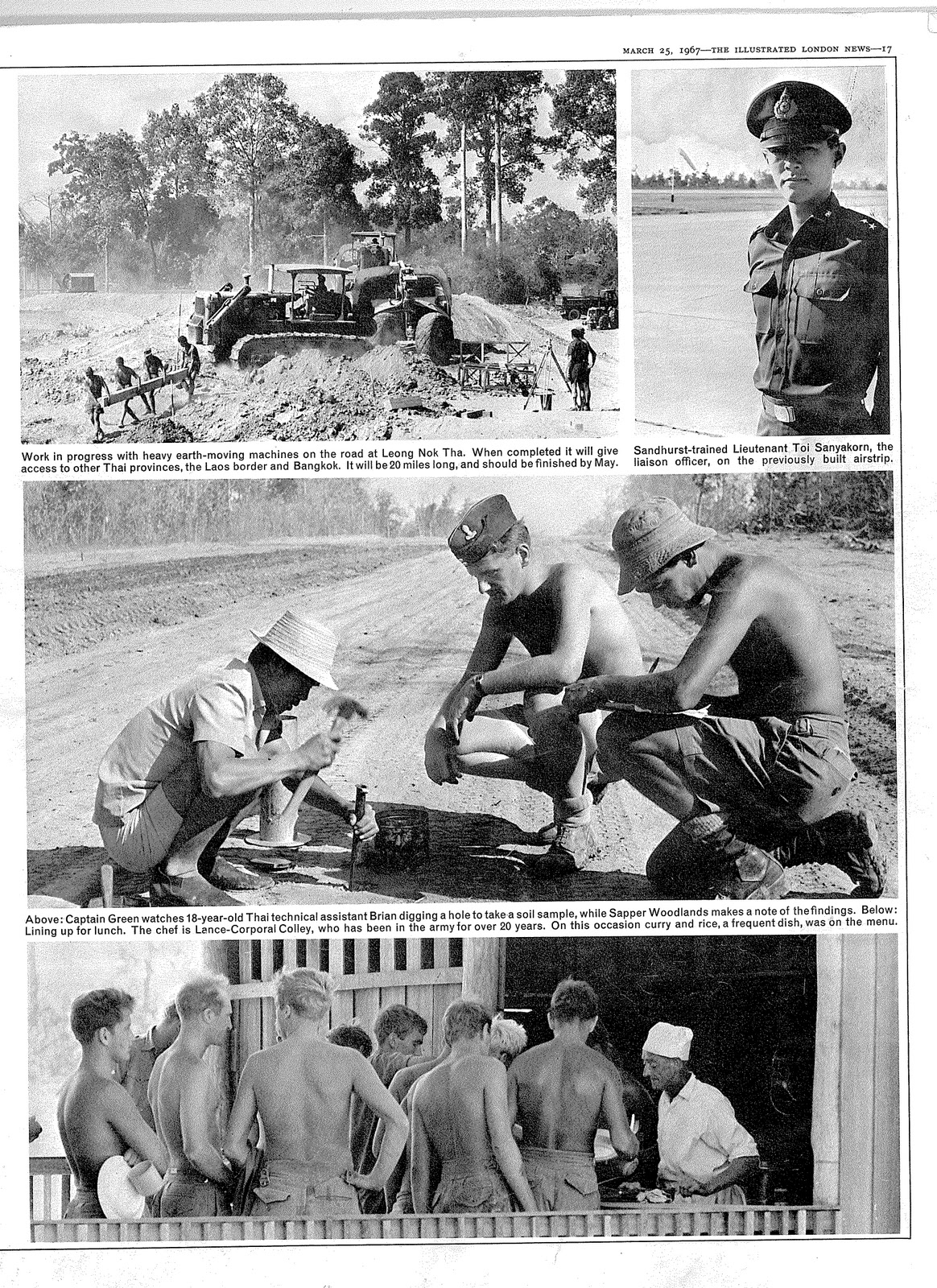
L/Cpl Harry Colley was a cook with the ACC and was the first Hong Khong camp cook. His immense experience cooking in the field was invaluable ensuring decent food for the troops. He had served during WW2 and a story of his wartime exploits is told by Capt Edwyn Green HERE. In the foreground Sapper Malcolm Macmillan is at work on a concrete base. Harry is working with his back to us at a field oven. When a more permanent cookhouse was built Harry cooked and served in a better environment. |
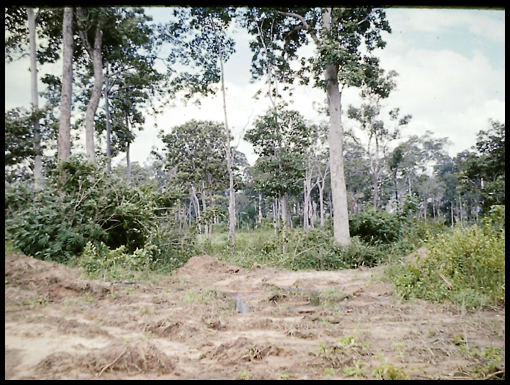
2 Troop were to build bridges four and five. Personnel from other 34 Sqn troops and other units in a variety of roles, lived and worked in the camp. Surveyors and plant operators being two of the roles mosty in demand. Here we see Stewart Hulley of 2 Troop 34 Sqn with Thai civilian workers, reconnoitering the virgin forest of the surveyors centerline. They walked ahead of the bulldozers checking for surface holes and water courses. virgin forest means the wearing of long Olive Green trousers and jungle boots. |
|
|
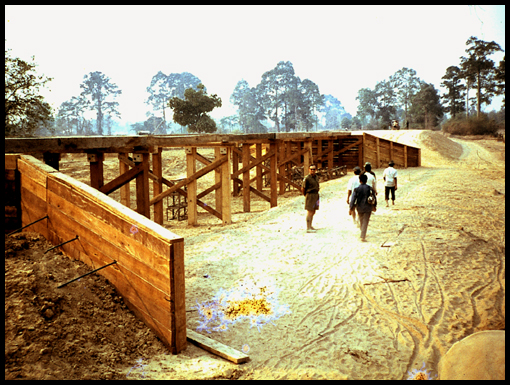
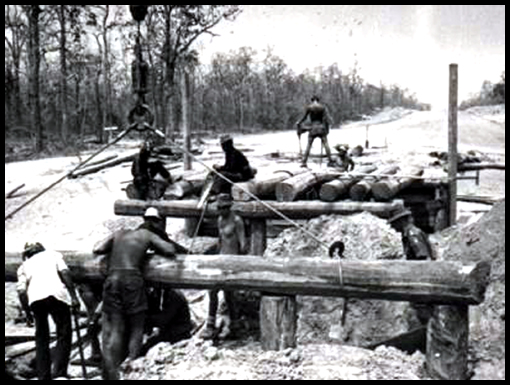
The wooden bridge design was known as a Class 24 and was either a piled version or a buried trestle. Bridges one, two were of the piled variety, bridges three and four were buried trestle. Expediency dictated the use of this form on
Bridges 3 and 4, as only one set of piling kit for the RB19s was available at the start
of the project. An interesting aside regarding the piling method, is that the piles when driven in were splitting. The answer to the problem was a metal cap |
Bridges 3 and 4 were of the buried trestle design and are pictured here. Local labour was used to boost the areas economy. The men had the hand skills needed to fashion tree trunks into piles and beams. The picture of bridge 3 has a Thai worker with and adze in his hand. This tool was used to fashion the component parts. Although not having the precision of sawmill cut timber, the hand fashioned tree trunks had an aesthetic crafted look. These bridges have long been replaced by modern concrete bridges. |
|
|
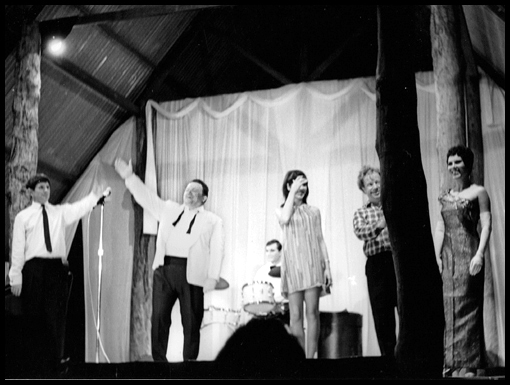
In early March, the isolated British Army outpost received a morale booster in the form of a Combined Services Entertainment Party. Harry Secombe, Anita Harris, Myrna Rose, Billy Burden and Johnny Ball with Don Phillips and Jeff Morley providing the music, entertained the troops with a variety show. The inhabitants of Hong Khong camp travelled to Crown to watch the show, but getting them to go back after was another story. A report on it will appear on the Post Crown page. |
The Sappers of 34 Sqn continued to graft on through March and April, not only working on the road but also a considerable amount of 'hearts and minds' work
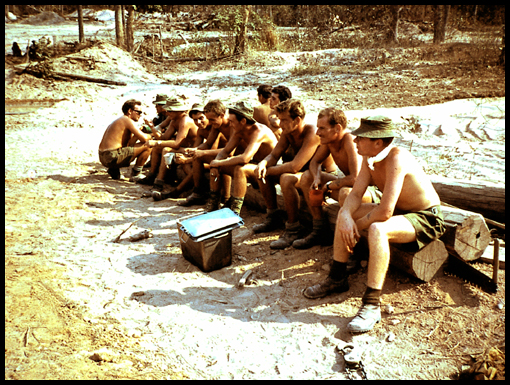
ranging from wells to water-catchment systems on temple roofs. This was important because communist insurgents from Laos, were targeting and killing policemen, village headmen and teachers. The road and the 'hearts and minds work' gave the people of the area another option instead of isolation and communism. The rollover shows Sappers of 2 Troop taking a well earned tea break. |
|
|
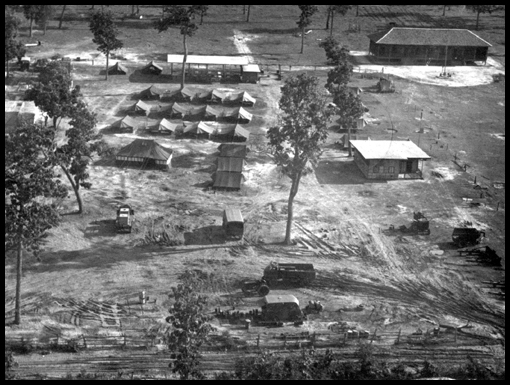
It was around this time in March that two helicopters of the FARELF RE Air Troop arrived. They stayed until the end of the project and canny Sappers of 34 Sqn soon found ways of occupying the second seat in the cockpit. Tony Bold was an enterprising young Sapper who managed to blag himself a ride down the road. The 'Chopper' he hitched a ride in was a Sioux AH1. The rollover shows his shot of Hong Khong camp as it was shortly before 34 Sqn left Post Crown. |
As May approached, and with it the end of their nine months in the Far East,
34 Field Squadron redoubled their efforts to achieve completion of the first phase of
the project. In the event the target of 12.5 km of completed earthwork, five bridges
and twelve culverts was achieved, together with a further 3 km of pilot track, the
concrete bases for Bridge 6 and a considerable amount of "hearts and minds" work
In all, the Squadron
had set a standard for the project which would prove a challenge to those who would follow.
|
|
|
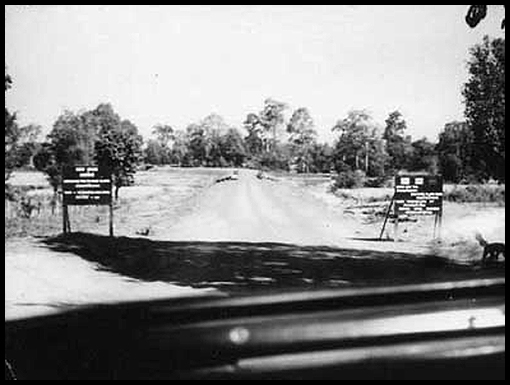
The opening ceremony for the first 12 kms of road, was performed by the Governor of Ubon on 29th April 1967, it was a Saturday. Major John Isaacs OC of 34 Fd Sqn spectates. The rollover was taken from a moving Land Rover about to cross the start line of the newly opened road. Major Isaacs was driving, the Governor was sitting beside him and I, as Maj Isaacs Radio Op was sitting in the back and took the picture through the windscreen. We drove the length of the road in convoy as the governor had his security escorting us. |
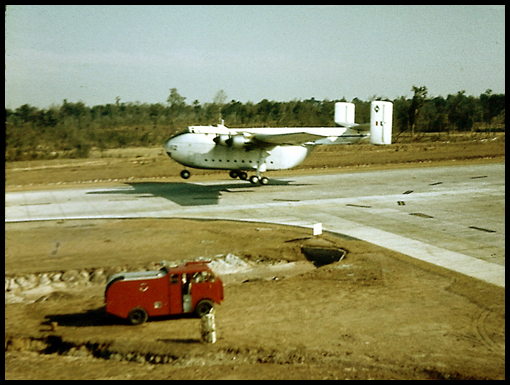
TThe main party of 34 Fd Sqn left Thailand for Singapore on Sunday the 30th of April 1967 aboard a Blackburn Beverley aircraft. They handed over to 59 Fd Sqn. The Beverley can carry 130 troops, 94 in the hold and 36 in the tail boom. When in flight the boom flexes alarmingly because of the wooden construction. Flying around 12,000 feet over the Gulf of Siam as it was then and looking down at the whitecaps far below, I had visions of myself freefalling down to a watery grave. |
|
But it didn't happen and I'm here to tell the 34 Thailand story. 34 Fd Sqn left Singapore for Tidworth on Tuesday 9th May 1967. They were leaving behind nine months of rigours on Crown and Post Crown, two unique peacetime operations for the Corps of Royal Engineers. Not one of them will have forgotten their experiences in Thailand. |
To view a higher resolution version of the images above, click on them. |
|